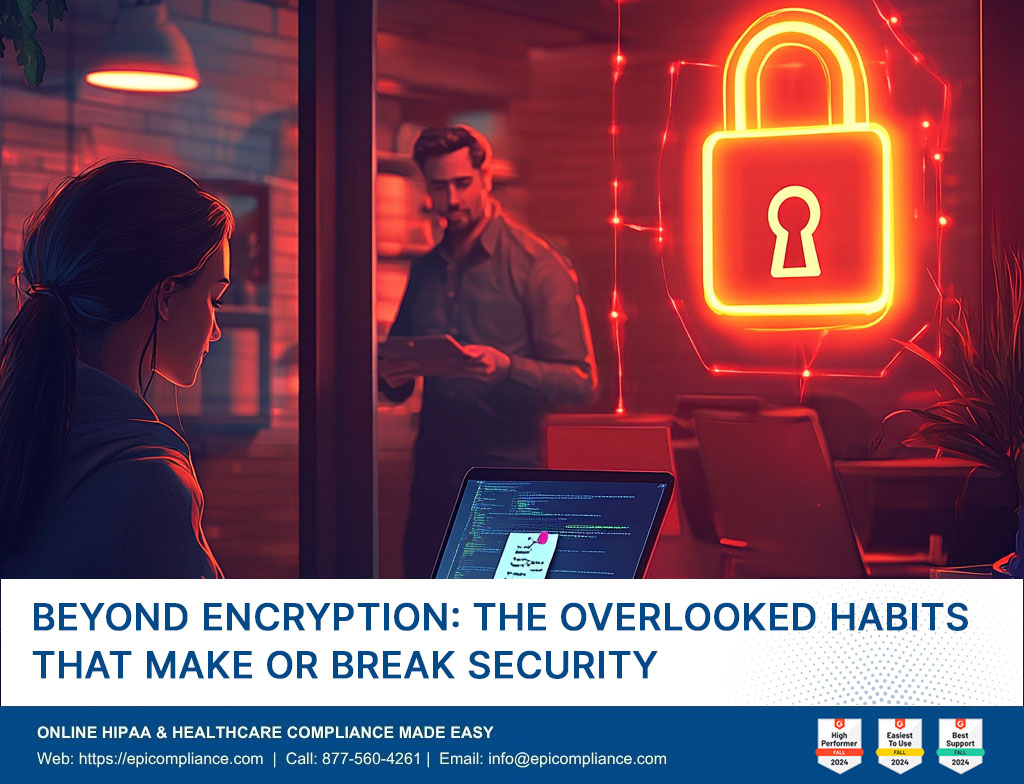
When most people hear “HIPAA Security,” they picture high-tech hackers typing furiously in a dark room. But here’s the truth: the biggest risks often come from the everyday habits we don’t think twice about.
That’s where encryption starts the conversation—but not where it ends.
The Door You Forgot to Lock
Think about your morning routine. You lock the front door, but do you double-check the garage? Or the back slider? One overlooked detail is all it takes. Healthcare data works the same way. Encryption locks the door—but if you leave your laptop in the car overnight or forward PHI to your personal email for “convenience,” you’ve left the back door swinging wide open.
Actionable Tip: Treat encryption like your deadbolt and your habits like the alarm system. Both matter.
The Coffee Shop Conundrum
We love our lattes, but here’s the risk: public Wi-Fi. Without strong protections, it’s like handing strangers your internet traffic on a silver platter.
In healthcare, sending PHI over a café’s free network—even accidentally—could trigger not just fines, but lawsuits. At home, that same habit could expose your banking passwords or private photos.
Actionable Tip: Always use VPNs on public Wi-Fi, and secure your home router with WPA3 and a password stronger than “password123.”
The Human Factor: Still the Weakest Link
Technology can’t save us from ourselves. A HIPAA-compliant system means nothing if employees write passwords on sticky notes or leave patient charts on the copier.
At home, the same principle applies—what good is encrypting your laptop if your kids use it to download sketchy games?
Actionable Tip: Build a culture of curiosity. In the office, encourage coworkers to call out sloppy security. At home, talk openly about why shortcuts online (like “free” downloads) are risky.
Why Reputation, Not Just Compliance, Is at Stake
Fines grab headlines, but trust is the real currency. Patients, colleagues, even your family—they all assume you’re guarding sensitive information. One slip can’t always be patched with money. Remember: in 2023, over 133 million healthcare records were exposed across 725 reported breaches. That’s not just numbers—that’s real people whose trust was compromised.
Actionable Tip: Reframe compliance from “avoiding fines” to “protecting trust.” That shift makes security everyone’s job, not just IT’s.
From Policy to Personal Habit
The key lesson? HIPAA Security isn’t about a single tool or rule—it’s about mindset. Just like brushing your teeth or buckling your seatbelt, encryption and secure habits should become automatic.
Ask yourself: If my laptop, phone, or email was stolen today, would I still sleep soundly tonight? If the answer is “no,” it’s time to strengthen the habits that support the tech.
Final Word
Encryption is powerful, but it’s only one piece of the puzzle. Real security lives in the daily choices you make at work and at home.
And if your organization wants to make compliance second nature—not just a checklist—EPICompliance and Taino Consultants are here to help you turn good intentions into real-world protection.

