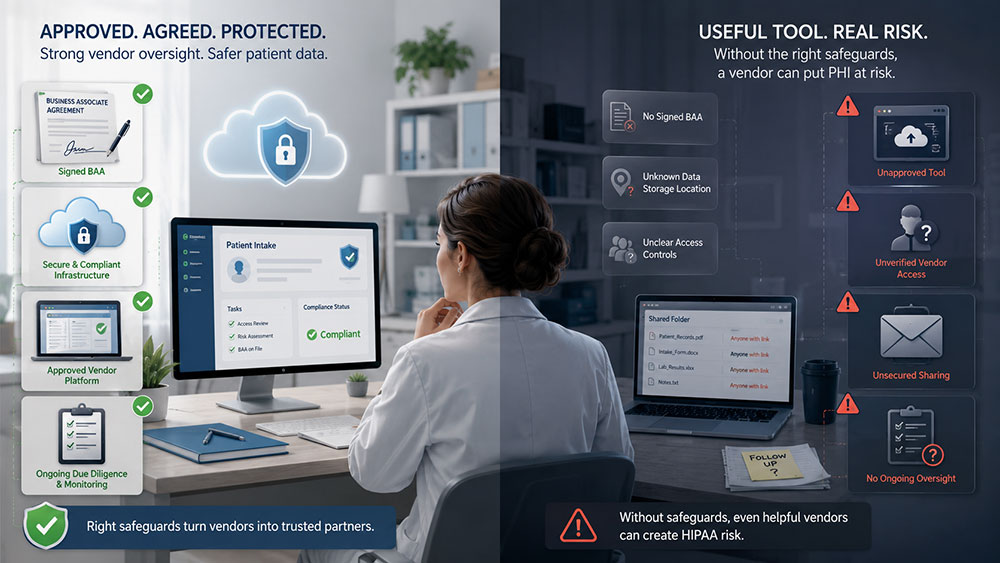
There is a quiet moment in healthcare operations that can create more risk than people realize.
A staff member uploads a patient list into a scheduling tool.
A manager sends billing files to an outside consultant.
An IT vendor requests remote access to troubleshoot a system.
A cloud platform stores reports.
A document disposal company picks up old records.
A software vendor maintains a patient portal.
Nothing about these moments feels unusual. In fact, most of them happen because people are trying to keep the organization running.
That is exactly why Business Associate oversight matters.
Healthcare work does not happen inside one office, one computer, or one system anymore. It moves through vendors, platforms, contractors, consultants, software tools, storage systems, and support services. Many of those relationships are legitimate and necessary. But when protected health information, or PHI, moves outside the organization, the responsibility does not simply disappear with the file.
The safest question is not, “Is this vendor useful?”
The safer question is, “Is this vendor approved to handle PHI, and do we have the right safeguards in place before the information is shared?”
Why This Vendor Question Is Getting Louder
Recent enforcement activity shows why this is more than a paperwork issue. Vendor problems are not theoretical. They have led to large penalties, corrective action plans, public notices, and difficult questions about whether the organization really knew who was handling its data.
The point is not to scare people away from vendors. Vendors are an important part of healthcare operations. The point is to make sure vendor relationships are reviewed before PHI leaves the organization. While there are many examples that show why this matters, the table below gives a quick view of how vendor-related issues can turn into serious compliance problems when oversight is missing.
| Organization | Amount | Issue | Practical reminder |
|---|---|---|---|
| CHSPSC LLC | $2,300,000 | Potential HIPAA Privacy and Security Rule violations after a cyberattack compromised the PHI of more than 6 million individuals. | Vendor access and security controls need to be understood before a problem happens. |
| MedEvolve, Inc. | $350,000 | Unlawful disclosure after the PHI of more than 200,000 individuals was left on an unsecured, internet-accessible server. | Cloud storage and server exposure are vendor-risk issues, not just IT issues. |
| Health Fitness Corporation | $227,816 | Failure to conduct an accurate and thorough risk analysis of ePHI that it maintained. | Risk analysis should include systems, vendors, and outside services that maintain ePHI. |
| Medical Informatics Engineering | $100,000 | Risk analysis failures tied to the impermissible disclosure of approximately 3.5 million patient records. | Basic security review gaps can become large compliance problems. |
| MMG Fusion, LLC | $10,000 | Unreported security incident involving PHI found on the dark web, along with risk analysis and notification failures. | Vendor incidents need quick escalation, documentation, and follow-up. |
The lesson is simple: a covered entity’s compliance program is only as strong as the vendor relationships it allows into the workflow.
What a Business Associate Really Means
In plain English, a Business Associate is generally an outside person or organization that performs certain services or functions for a HIPAA covered entity and needs access to PHI to do that work.
This can include vendors or service providers involved in:
- Billing or claims processing
- Legal, accounting, consulting, or administrative services involving PHI
- IT support or remote access
- Cloud storage
- EHR or software maintenance
- Data analysis
- Transcription
- Document storage or destruction
- Patient communication tools
- Scheduling or reminder platforms
- Third-party support services that handle PHI
Not every vendor is automatically a Business Associate. A landscaping company, for example, usually does not become a Business Associate simply because it works outside the building. A healthcare provider receiving PHI for treatment purposes may also fall under a different HIPAA pathway.
The key issue is the function being performed.
If an outside person, company, platform, or service creates, receives, maintains, or transmits PHI on behalf of the organization, the relationship needs to be reviewed before information is shared.
That review matters because PHI does not become less sensitive when a vendor handles it. Patient names, insurance data, billing details, schedules, medical record numbers, diagnoses, treatment notes, portal data, and scanned forms can all carry risk when they move outside the organization’s direct control.
The BAA Is Not Just a Form
A Business Associate Agreement, often called a BAA, is more than a document that gets signed and forgotten.
A good BAA helps define what the vendor is allowed to do with PHI and what safeguards are expected. It should make the relationship clearer before there is confusion, pressure, or a problem.
A Business Associate Agreement should help answer practical questions such as:
- What PHI can the vendor access?
- Why does the vendor need it?
- What is the vendor allowed to do with it?
- What safeguards must the vendor use?
- Can the vendor use subcontractors?
- What happens if there is a security incident or breach?
- How quickly must the vendor report a problem?
- What happens to the PHI when the relationship ends?
- How is access removed, returned, destroyed, or restricted?
This is also where the 2026 conversation matters. HHS has proposed updates to the HIPAA Security Rule that would make several security expectations more specific and easier to verify. If finalized as proposed, organizations and Business Associates would need to pay closer attention to documented security reviews, multi-factor authentication, encryption of ePHI, vulnerability scanning, penetration testing, and written verification that safeguards are actually working.
That does not mean every manager needs to become a cybersecurity expert. It does mean the BAA and the vendor review process should be strong enough to ask practical questions: Does the vendor use MFA? Is ePHI encrypted at rest and in transit? How often are systems tested? Who confirms the controls? How quickly will the vendor notify us if something disrupts access or creates a security concern?
There is another 2026 issue to keep in mind. If substance use disorder records subject to 42 CFR Part 2 are involved, vendor workflows should account for those additional confidentiality rules, including limits on use and redisclosure. A general vendor approval process may not be enough if the data carries extra restrictions.
That clarity matters because vendor risk often hides inside convenience.
A tool may be easy to use.
A service may be popular.
A vendor may be friendly and responsive.
A platform may promise efficiency.
A workaround may save time.
But convenience is not the same as compliance.
If PHI is involved, the organization needs to know whether the vendor relationship is approved, documented, and limited to what is necessary.
The Real Problem Is Not Always the Vendor
It is easy to think Business Associate risk begins with a bad vendor. Sometimes it does. But in daily healthcare operations, the bigger problem is often unclear workflow.
Who is allowed to approve a new vendor?
Who checks whether a BAA is needed?
Where are BAAs stored?
Who tracks renewal dates or contract changes?
Who confirms that vendor access is limited?
Who removes access when the service ends?
Who reviews subcontractor concerns?
Who gets notified if the vendor reports a security incident?
If the answer is, “I think someone handles that,” the process may already be too fragile.
Business Associate oversight works best when it is not left to memory, email chains, or assumptions. It needs a simple, repeatable process that staff and managers can follow before PHI is shared.
The issue is not only whether the organization has a BAA somewhere. The issue is whether the organization can show that vendor relationships involving PHI are identified, reviewed, documented, monitored, and updated when things change.
How Vendor Risk Shows Up in Real Life
Business Associate issues are not always dramatic. They often begin with ordinary decisions.
A department starts using a free online file converter because a document will not open.
A billing team sends a spreadsheet to an outside consultant through regular email.
A manager signs up for a cloud tool without confirming whether PHI will be stored there.
A former vendor still has access to a portal.
A subcontractor handles PHI, but no one reviewed that downstream relationship.
A vendor reports suspicious activity, but staff are not sure who should receive the notice.
A staff member assumes a platform is safe because another healthcare office uses it.
None of these situations automatically means a breach occurred. But each one creates a question the organization needs to answer.
Was PHI involved?
Was the vendor approved?
Was a BAA required?
Was one in place?
Was access limited?
Was the issue documented?
Was follow-up completed?
Those questions are much easier to answer when the organization has a clear Business Associate process before something goes wrong.
Why Business Associate Oversight Is Also a Security Issue
Business Associate management is sometimes treated as a contracting task only. That is too narrow.
If a vendor handles electronic protected health information, or ePHI, then security also matters. Vendor access can affect confidentiality, integrity, and availability.
In plain English:
- Confidentiality means patient information stays private.
- Integrity means the information is not improperly changed or damaged.
- Availability means the information is accessible when staff need it.
A vendor problem can affect any of these. A cloud system outage may interrupt access. A compromised vendor account may expose information. A poorly controlled remote access arrangement may create an entry point. A subcontractor issue may spread risk beyond the original vendor.
That is why Business Associate oversight connects directly to HIPAA Security habits such as access control, risk analysis, incident response, documentation, and workforce training.
The contract matters.
The workflow matters.
The safeguards matter.
The proof matters.
The follow-up matters.
The Practical Business Associate Playbook
Business Associate oversight does not have to become complicated. The more practical the process is, the more likely people are to use it.
-
Identify who may touch PHI
Start with a current list of vendors, contractors, consultants, platforms, systems, and outside services that may create, receive, maintain, or transmit PHI.
Do not limit the list to obvious vendors. Include software tools, cloud platforms, billing support, IT support, document storage, disposal services, consultants, and communication tools.
-
Ask before sharing
Staff should know that PHI should not be uploaded, sent, stored, or processed through an outside tool or vendor unless the relationship has been reviewed and approved.
A simple rule helps:
When in doubt, ask before PHI goes out.
-
Confirm whether a BAA is needed
Not every outside relationship requires a BAA, but guessing is risky.
The organization should have a clear process for determining when a BAA is required and who approves it.
-
Limit access to what is needed
Even approved vendors should not receive more information than necessary. Vendor access should match the work being performed.
If a billing vendor only needs certain billing details, do not provide broader clinical records unless there is a valid reason.
-
Track subcontractor concerns
Business Associate risk can continue downstream. If a Business Associate uses another company to help perform services involving PHI, that subcontractor relationship also needs appropriate safeguards.
Managers do not need to memorize every legal detail, but they should know whether subcontractors are addressed before PHI moves further away from the organization.
-
Document vendor incidents and concerns
If a vendor reports suspicious activity, sends information to the wrong place, loses access control, delays notification, or uses an unexpected method, document the concern and escalate it through the approved process.
Quiet vendor problems can become larger compliance problems when they are not tracked.
-
Review access when services change or end
Old vendor access is a common risk. When a service ends, a contract changes, a platform is replaced, or a vendor’s role narrows, access should be reviewed and removed when no longer needed.
-
Build in security proof
For vendors that handle ePHI, approval should not stop with a signature. The organization should know whether key safeguards are expected, documented, and reviewed. This is especially important as HIPAA Security expectations continue moving toward more specific proof of performance.
-
Flag special data early
Some information may require extra handling. If Part 2 substance use disorder records, sensitive program records, or other restricted data may be shared with a vendor, identify that before the workflow starts.
The Manager’s July Check
Managers do not need to become contract lawyers to support Business Associate oversight. They do need to know whether the process works in real life.
Start with these questions:
- Do we have a current list of vendors, tools, platforms, and outside services that may handle PHI or ePHI?
- Do staff know which vendors and tools are approved?
- Do staff know who to ask before sharing PHI with a new vendor or platform?
- Are BAAs completed before PHI is shared when required?
- Are vendor permissions limited to what is necessary?
- Do we know whether subcontractors may be involved?
- Are vendor security incidents, concerns, and access changes documented?
- Do we remove vendor access when services change or end?
Do vendor agreements and reviews address current security expectations, including MFA, encryption, testing, incident reporting, and written verification where appropriate?
If Part 2 substance use disorder records may be involved, do we have a clear process for limiting use, disclosure, and redisclosure?
If any of these questions are hard to answer, that is not a failure. It is a useful signal. It shows where the process needs to be clarified before a vendor issue creates pressure.
The Bigger Lesson
Business Associate oversight is not about distrusting every vendor.
It is about respecting the fact that PHI remains protected even when someone else is helping with the work.
A good vendor can still create risk if the relationship is not reviewed.
A useful tool can still be the wrong place for PHI.
A signed agreement can still fail if no one follows the process.
A vendor issue can still become the organization’s documentation problem.
The goal is not to stop using outside support. The goal is to use outside support wisely.
Know who is handling PHI.
Confirm the relationship.
Use the right agreement.
Limit the access.
Document the process.
Review it when things change.
That is the heart of July’s reminder.
Before PHI leaves your hands, know who is holding it.
How Structured Support Helps
HIPAA security shouldn't be a burden, but a blueprint for resilient practice. EPICompliance provides a centralized platform for managing training, policy templates, and automated task lists, keeping your team organized and audit-ready. When you need to align these tools with your specific operations, Taino Consultants provides expert guidance to help you navigate the Security Risk Assessment (SRA) process and right-size your risk management plan.
Take the next step
Current Users: Log in to review your monthly security reminders, compliance tasks, and ensure your documentation reflects your current workflows.
New to Us? Discover how our combined tools and guidance reduce uncertainty and build a culture of compliance.
References
- Electronic Code of Federal Regulations. (n.d.-a). 45 C.F.R. § 164.314: Organizational requirements. Retrieved June 24, 2026, from https://www.ecfr.gov/current/title-45/subtitle-A/subchapter-C/part-164/subpart-C/section-164.314
- Electronic Code of Federal Regulations. (n.d.-b). 45 C.F.R. § 164.502: Uses and disclosures of protected health information: General rules. Retrieved June 24, 2026, from https://www.ecfr.gov/current/title-45/subtitle-A/subchapter-C/part-164/subpart-E/section-164.502
- Electronic Code of Federal Regulations. (n.d.-c). 45 C.F.R. § 164.504: Uses and disclosures: Organizational requirements. Retrieved June 24, 2026, from https://www.ecfr.gov/current/title-45/subtitle-A/subchapter-C/part-164/subpart-E/section-164.504
- U.S. Department of Health and Human Services, Office for Civil Rights. (2013, January 25). Business associate contracts. https://www.hhs.gov/hipaa/for-professionals/covered-entities/sample-business-associate-agreement-provisions/index.html
- U.S. Department of Health and Human Services, Office for Civil Rights. (2019, May 24). Business associates. https://www.hhs.gov/hipaa/for-professionals/privacy/guidance/business-associates/index.html
- U.S. Department of Health and Human Services, Office for Civil Rights. (2021, July 16). Direct liability of business associates. https://www.hhs.gov/hipaa/for-professionals/privacy/guidance/business-associates/factsheet/index.html
- U.S. Department of Health and Human Services, Office for Civil Rights. (2024, December 27). HIPAA Security Rule Notice of Proposed Rulemaking to strengthen cybersecurity for electronic protected health information. https://www.hhs.gov/hipaa/for-professionals/security/hipaa-security-rule-nprm/factsheet/index.html
- Federal Register. (2025, January 6). HIPAA Security Rule to strengthen the cybersecurity of electronic protected health information. https://www.federalregister.gov/documents/2025/01/06/2024-30983/hipaa-security-rule-to-strengthen-the-cybersecurity-of-electronic-protected-health-information
- U.S. Department of Health and Human Services, Office for Civil Rights. (2026, January 30). Fact sheet: 42 CFR Part 2 final rule. https://www.hhs.gov/hipaa/for-professionals/regulatory-initiatives/fact-sheet-42-cfr-part-2-final-rule/index.html