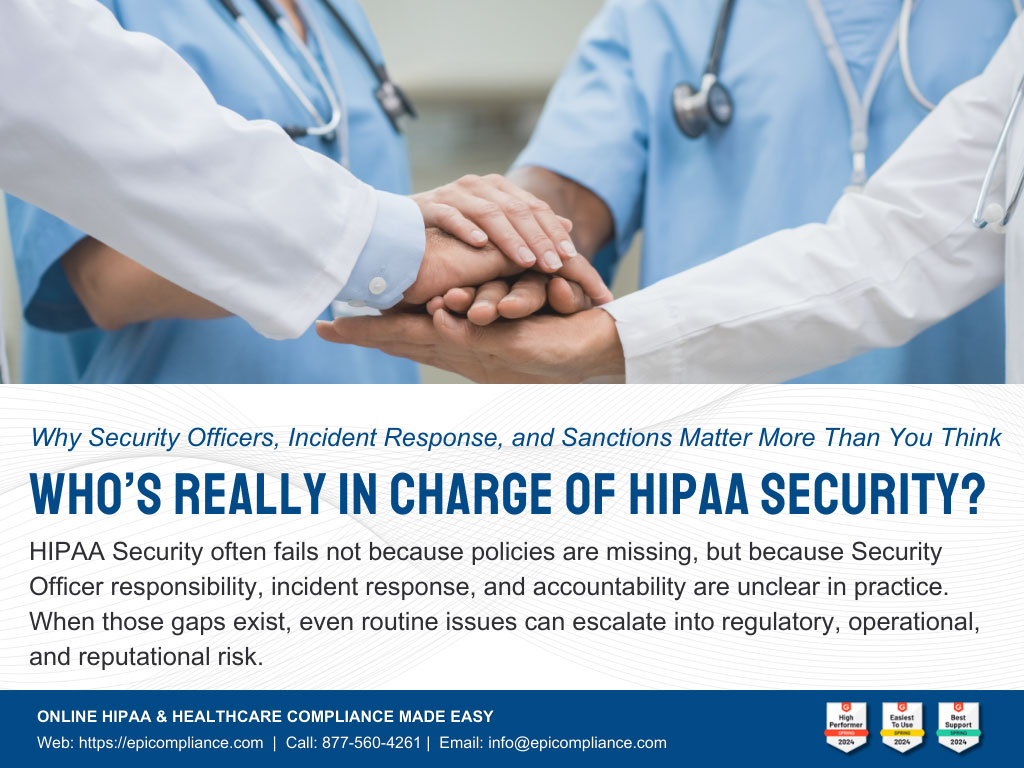
In many healthcare organizations, HIPAA Security lives in a gray zone. IT assumes compliance owns it. Compliance assumes IT has it covered. Leadership trusts that policies alone are enough.
Then a staff member clicks the wrong link. A laptop goes missing. An employee bypasses protocol “just this once.”
HIPAA Security does not fail because organizations do not care. It fails because roles, responses, and consequences are unclear in daily operations.
February’s key security themes—Security Officer responsibility, security incidents, and sanction policies—form the foundation of an effective HIPAA Security program. Together, they determine whether an organization responds with control or confusion when something goes wrong.
The Security Officer Role: More Than a Name on Paper
HIPAA requires organizations to designate a Security Officer, but it does not require that role to be full-time. While this flexibility helps smaller organizations, it also creates risk when the role exists only in theory.
In practice, the Security Officer should:
- Understand how electronic protected health information (e-PHI) moves through the organization
- Coordinate across IT, compliance, leadership, and frontline staff
- Ensure security policies reflect real workflows, not idealized ones
- Act as the central authority during security incidents
When this role is unclear or symbolic, decisions are delayed, accountability is fragmented, and incident response becomes reactive instead of controlled.
From a business perspective, uncertainty during a security event increases exposure—not just to regulatory risk, but to operational disruption and reputational harm.
Security Incidents: Not Every Problem Is a Breach—but Every One Matters
Many organizations mistakenly believe security incidents only count when data is confirmed lost or stolen. HIPAA’s definition is broader.
Security incidents include:
- Misdirected emails containing e-PHI
- Unauthorized access attempts
- Malware alerts or system anomalies
- Lost or stolen devices—even if encrypted
- Suspicious behavior involving system access
What regulators look for is not perfection, but evidence of awareness, documentation, and response. Even incidents that result in no harm must demonstrate that the organization recognized the risk and acted appropriately.
Organizations that ignore “near misses” often struggle during audits because they cannot show a consistent security posture.
In practice, a documented response matters as much as the outcome.
Sanction Policies: Accountability That Protects the Organization
Sanction policies are often uncomfortable to discuss. Leadership may worry about morale, while managers fear appearing punitive. However, HIPAA does not require punishment—it requires consistent enforcement.
An effective sanction policy:
- Applies to all roles, including leadership
- Differentiates between accidental mistakes and repeated or willful violations
- Reinforces expectations without creating fear
- Demonstrates organizational accountability
Without enforcement, policies lose credibility. Without documentation, enforcement loses defensibility.
From a trust standpoint—both for patients and regulators—organizations that address violations openly and consistently are viewed as responsible stewards of sensitive information.
Practical Steps Healthcare Managers Can Take Now
Operational Checklist
- Confirm your Security Officer is clearly identified, trained, and empowered
- Define what staff should report as a security incident, using real examples
- Ensure every incident is documented, even if resolved internally
- Review your sanction policy for consistency and fairness
- Communicate expectations so staff feel safe reporting issues early
Pro Tip
If staff fear consequences more than security risks, incidents will go unreported. Strong HIPAA Security programs encourage visibility, not silence.
How Structured Support Helps
Managing HIPAA Security internally can be challenging, especially when resources are limited. This is where structured compliance support can add real value.
EPICompliance is designed to help organizations approach HIPAA Security in a way that aligns with real-world healthcare operations. By centralizing training, risk awareness, and compliance documentation, it helps organizations maintain consistency without overwhelming staff or relying on fragmented tools.
For organizations already using EPICompliance, reviewing your current risk assessment and training materials is an opportunity to ensure they reflect how your organization operates today. For those exploring compliance solutions, having guided, centralized support can reduce uncertainty and improve confidence.

